Wx

Sunday, August 20, 2023

Arizona Century Mark - Not

While the some of the nation is basking in Arizona style temperatures here is a summary of our days of summer heat:

So we had at most 55 days in a row of 100° F or greater. We had 63 days total of of 100° F or greater and 11 days of 110° F or over. So it looks like we will most likely not reach the Century Mark this year.

We definitely are not used to double digit humidity


Monday, August 7, 2023

M20 Trifid Nebula & M21 Webb's Cross Cluster

The Trifid, meaning three lobed - I don't know about you but three lobed is not what I see!?! NGC 6514 (M20) is 4,240 Light years from my telescope. The nebulosity is lit up by the energy of  a star in middle of the dark veins. The group of stars in the Lower right of the photo is M21 Webb's Cross open star cluster. I purposely toned down the stars as to not blow out the Trifid. Webb's Cross is actually closer to us than Trifid at 3,930 light years. I took this photo on August 5-6, 2023. I took 189 frames lasting 30 seconds each. The air was pretty turbulent so I had to dump 98 frames, keeping only 91 for the stack. I will ultimately make another run at this beautiful nebula when the seeing conditions improve in the coming weeks.


Thursday, June 29, 2023

Massive Sunspot 3354


Massive Sunspot 3354 is so large you could fit 10 earths side by side into it.
Left half Hydrogen Aplha Right Half White Light Filter 99.9% 2023-06-29 12:27


Wednesday, June 28, 2023

M17 NGC 6618 The Swan Nebula

The swan or Omega Nebula is about 6,000 light years from my telescope. However it is 15 light years wide! What is amazing is we are seeing it edge on can you if we saw it face on it would be 40 light years in diameter! NGC 6618 lies embedded in the nebulosity and causes the gases of the nebula to shine due to radiation from these hot, young stars. 2023-06-27 10:00 PM to 2023-06-28 1:00 AM 133 frames taken, 63 thrown out for turbulence. 


Wednesday, June 21, 2023

NGC6611 M16 The Eagle Nebula

 The Eagle Nebula is part of a diffuse emission nebula, about 5700 light-years distant and is actually 55 by 70 light years across. In the middle is the so called pillars of creation, as new stars are forming there.

5340 total exposure time in seconds, Camera cooled to 0°C, 30 seconds average exposure time, 178 of 247 frames processed/stacked.


Saturday, June 17, 2023

M8\NGC6523 Lagoon Nebula

M8 is the opening act for Nebula season, so I grabbed it last night. The light took 5,200 years to reach my camera. The massive stars embedded within the nebula give off enormous amounts of ultraviolet radiation, ionizing the gas and causing it to shine. It is low on the horizon for most of the United States and therefor subject to atmospheric turbulence. For Tucson it is low but not too bad (34 images rejected for turbulence).,210 frames of 30 seconds = 1 hour 45 minutes of exposure.
ASTAP for plate solving, mount sync, and frame stacking, Siril for histogram stretching and color verification, StarNet for star equalization, DarkTable for final composition and copyright.


Wednesday, May 31, 2023

Evening Star - More like Evening Planet

I often get asked what is that immensely bright star? It is often called the "Morning Star" or the "Evening Star" but, it is a planet! The planet Venus - it is not a star at all... The word planet comes out of Greek meaning to wanderer. It is the brightest celestial object out there right now - third brightest after the Sun and Moon. Here is what Venus looks like through my 9 1/4 inch wide telescope. All we can see is a thick, toxic atmosphere filled with carbon dioxide and thick, yellowish clouds of sulfuric acid that trap heat, causing a runaway greenhouse effect. Surface temperatures on Venus are about  900°F – hot enough to melt lead. Venus has crushing air pressure at its surface, 90 times that of Earth – similar to the pressure of a mile below the ocean on Earth. The clouds are so dense all we get is a very bland picture. Since, Venus is semi-close the horizon the view is quite turbulent. To obtain this picture I have to take over 2000 frames and then pick out only the ones that are lucky enough to be taken the during times when the atmosphere is settled down. Hence they call this "lucky imaging". I have an semi-automated process that make it way easier than it sounds.😁 By the way the light takes 6 minutes and 9 seconds to get to us. 

Friday, May 26, 2023

M101 & Super Nova Death of a Star

The supernova (SN 2023ixf) was formed when a star, much more massive than our own sun, ran out of fuel to burn in its core. Since the core could not support the mass of the star any more, the star collapsed on itself and created a gigantic explosion. This particular super nova is 21 million light years away. So this star began it's death implosion 21 million years ago...  The arrow in my picture points to SN 2023ixf which is near the M101 Pinwheel galaxy.


Wednesday, April 19, 2023

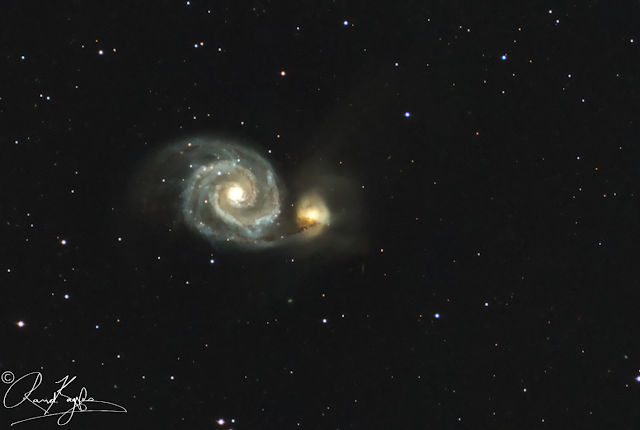
NGC5194 AKA M51 NGC5195


 The Whirlpool Galaxy, also known as Messier 51a or NGC 5194, lies in the constellation Canes Venatici, and was the first galaxy to be classified as a spiral galaxy. It is about 31 million light-years away from Earth and 76,900 light years in diameter. The companion galaxy is NGC 5195. (This first light for my Hyperstar)


Saturday, March 18, 2023

2022 Starr Ridge PWS Weather Summary


We had a 19 day streak out of the 56 total days of 100° F 
Also on one day we had temps vary by 47°F and one day where the temps only varied 4° F


The Dew Point makes the monsoon so easy to identify - blue bands


If it is going to rain it will probably be after 2 o'clock to 5 o'clock seem like a good bet.

A nice breeze in the afternoon is common as well as at least one gust in the 30's MPH a month

This graph tells what wind direction is favored by month

This graph tells us which wind direction is promenate for any wind speed

This graph tells us which direction the wind came throughout the year

Here we can see as an example on any given day the wind travelled from 114.2 miles away
Also on any given day only 1.96% of the time with there be no wind at all


Thursday, March 2, 2023

Snow Kissed Desert & Cacti

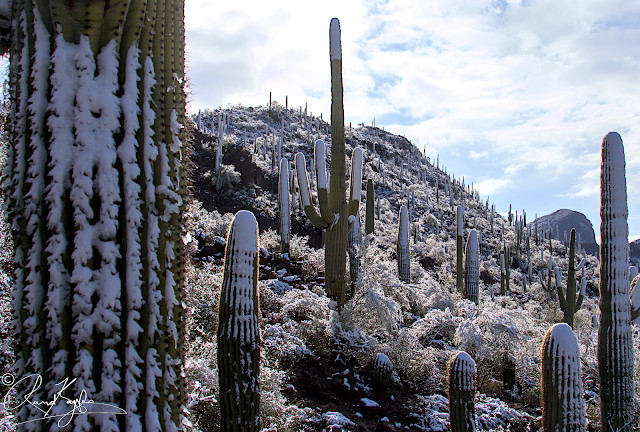
 I am totally aware this is too many photos, but I cannot help myself when it comes to snow in the desert. Trust me there were many more (504 total). So just scan and pick your favorites.


I have shown you this crested saguaro before but fringed with snow!?!


Saguaros protecting themselves from freezing keeping the snow on the outer edge of the rib.


The saguaros lost their snow in clumps and for some reason the snow only stuck to one side


Snow Touched Mule Deer in the Desert

 It was awesome finding this herd of mule deer on my desert snow hike today. They were certainly not camera shy.


This little guy was enjoying the winter wonderland with the elders


Goodbye